For indie authors who’ve yearned to enter foreign markets but halted at the cost of professional translation, AI Translations for Authors by James Blatch, the creator of Ads for Authors and Self Publishing Launchpad, promises a practical middle ground. This is no not a quick-and-dirty AI dump, but a structured, multi-pass system designed to produce results that don’t read like a translation.
Unlike a basic AI prompt, AI Translations for Authors teaches a multi-pass translation system built around a Global Style Sheet, a bespoke language guide for your book that keeps tone, character voice, and consistency intact across the entire manuscript.
Who Is It For?
The course is aimed squarely at indie authors who self-publish and want to expand into non-English markets without the traditional expense. Translating a book the old-fashioned way costs thousands of dollars, something that’s kept indie authors out of foreign markets for over a decade. This course positions itself as the solution for authors who are willing to put in some methodical work upfront.
The Core Premise
The central argument is that simply feeding a manuscript into an AI tool produces inconsistent, error-prone results. An AI has no idea that a dark interrogation scene needs different pronoun choices than a love scene, and it can’t distinguish a deliberate storytelling choice from a mistake it needs to correct. Blatch developed this course after receiving reader reviews criticising his early AI translations, and spent six months refining a more rigorous approach.
What’s Inside
As mentioned, the course is built around a “multi-pass” system, starting with a Global Style Sheet, a comprehensive language bible for each book that covers grammar rules, speech marks, voice, formal and informal address, character relationship dynamics, idioms, and long-running subtleties such as recurring jokes.
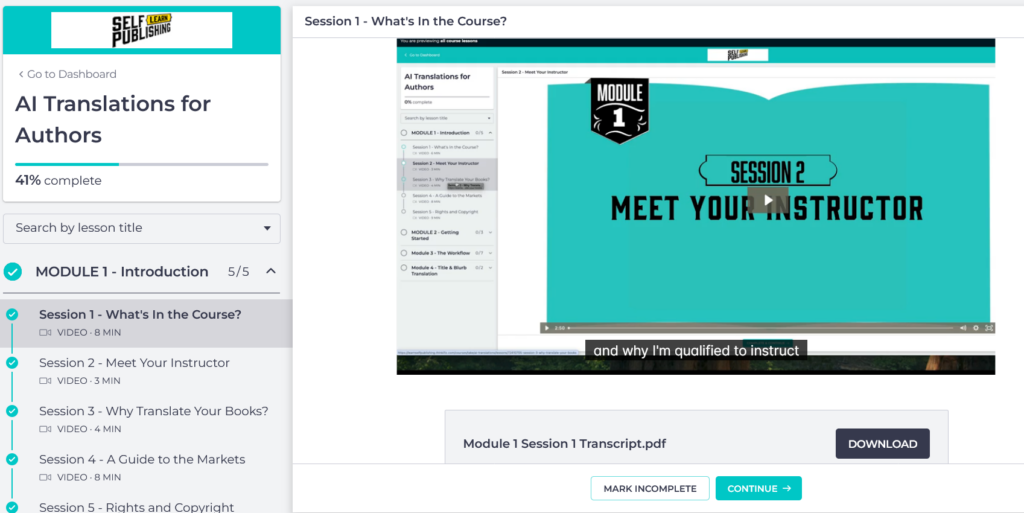
The curriculum spans four modules: why you should translate now; AI tools and workflows; the full multi-pass translation process; and how to localise your title and blurb for each market (not just literal translation, but what actually sells in that country). The course also covers the 2026 legal landscape of AI copyright across the USA, the EU, and the UK.
Three workflow paths are offered to suit different author situations: a rapid out-of-the-box approach for large backlists, an AI-human hybrid method, and a more thorough chapter-by-chapter manual pass using custom prompt templates.
The tools covered include Claude, ChatGPT, and Gemini for fiction, plus specialised author tools such as ScribeShadow and GlobeScribe. Over 60 starter prompts are included, along with access to an exclusive Facebook community.
Market Opportunity
The course highlights the potential to reach 13 new markets simultaneously, with Germany, France and Spain flagged as the “Big Three” — less saturated markets and offering easier paths to profit than the UK and USA. Early student testimonials reference grossing nearly $17,000 in a single year from a small number of translated titles.
Price & Access
The course is priced at $399 as a one-off payment, or 12 monthly instalments of $39, and gives you lifetime access and a 30-day no-questions-asked refund policy.
James also points out in Module 2 that using the required premium levels of AI/LLM engines to power the work involved incurs additional costs. This price range could be between $10 and $50 per month and could be a temporary upgrade whilst doing the translation work.
Recently, Kindle introduced an AI transaction tool. Read our deep dive here: Kindle Translate vs AI Translations for Authors